Cupping and acupuncture are often mentioned together, and many acupuncturists also offer cupping. They are different treatments, though: one uses suction cups on the skin, the other uses very fine needles. This guide explains how they differ, where they overlap, and how the points used in hijama and cupping relate to acupuncture points.
At a glance
- Cupping uses suction cups; acupuncture inserts very fine needles into specific points.
- Cupping leaves round marks; acupuncture usually leaves none.
- Many hijama and cupping points sit close to well-known acupuncture points, such as the point between the shoulders at the base of the neck.
- Both have been studied for pain. Acupuncture has been researched far more than cupping.
What is the difference between cupping and acupuncture?
| Cupping | Acupuncture | |
|---|---|---|
| Tool | Glass, plastic or silicone cups with suction | Very fine, single-use needles |
| What happens | Suction lifts the skin into the cup; in hijama, light scratches draw a little blood | Needles are inserted into points and left for a short time |
| Sensation | A firm pull, like a deep massage | A brief prick, then often a dull ache or tingling |
| Marks | Round marks for one to two weeks | Usually none |
| Area covered | Each cup covers a few centimetres | Each needle works on a precise point |
| Tradition | Many cultures, including Islamic (hijama), Chinese and Middle Eastern medicine | Mainly Chinese medicine |
Do hijama points and acupuncture points overlap?
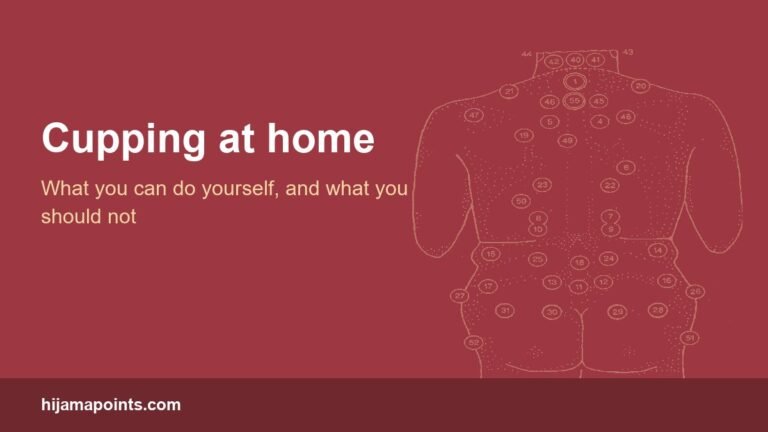
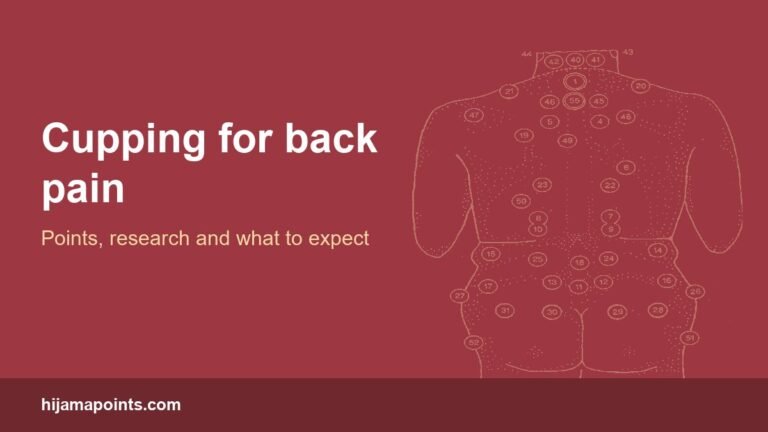
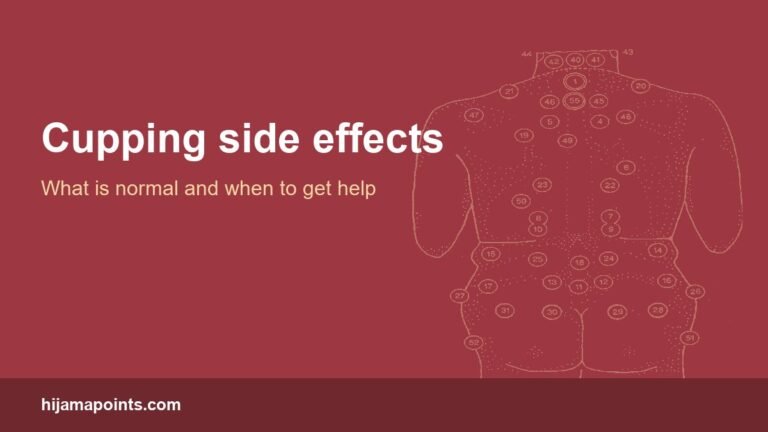
Often, yes. Because a cup covers a wider area than a needle, a cupping point usually sits over or near one or more acupuncture points. For example, point 1 on our back map, between the shoulders at the seventh neck vertebra, is in the same place as the acupuncture point GV14 (Dazhui). The kidney points 9 and 10 sit near BL23 (Shenshu), and points 53 and 54 at the back of the knee near BL40 (Weizhong).
Points are not always chosen for the same reasons, however. Hijama point choice draws on the Sunnah points, traditional practice and practitioner experience, while acupuncture follows the meridian system of Chinese medicine. See every numbered point on our hijama and cupping points chart.
What does the research say?
Both treatments have mostly been studied for pain. Acupuncture has a much larger body of research. Cupping research is growing but most trials are small: reviews suggest cupping may reduce chronic pain, neck pain and low back pain in the short term, with low-quality evidence overall. No good trials compare cupping and acupuncture head to head, so it is not possible to say one is better.
Can you have cupping and acupuncture together?
Yes. Many practitioners use them in the same session, for example needles first and then cups over the same area. If you see different practitioners for each, tell both what you are having. The usual safety advice applies to both: talk to your doctor first if you have a bleeding or clotting disorder, take blood-thinning medicines, are pregnant or have a heart condition or a pacemaker.
Which should you choose?
- If you want a needle-free treatment, cupping is the obvious choice.
- If marks would be a problem, for example before an event, acupuncture usually leaves none.
- If you want hijama for its place in the Sunnah, see what is hijama and our 9 Sunnah hijama points.
- Whichever you choose, use a trained practitioner and keep your doctor informed.
Frequently asked questions
Is cupping a type of acupuncture?
No. Cupping uses suction cups and acupuncture uses needles. They are often offered together and share some of the same points.
Does hijama use acupuncture points?
Many hijama points sit close to acupuncture points, but hijama points are chosen from the Sunnah points, traditional practice and experience rather than the meridian system.
Is cupping or acupuncture better for pain?
There are no good head-to-head trials. Acupuncture has more research behind it; cupping research is smaller and lower quality, but suggests it may help some types of pain in the short term.
Can I have cupping after acupuncture on the same day?
Yes, many practitioners combine them. Tell each practitioner about the other treatment.
Sources and further reading
- Cramer H et al. Cupping for chronic pain: a systematic review and meta-analysis – Journal of Pain, 2020
- Kim S et al. Cupping therapy for neck pain: a systematic review and meta-analysis – BMJ Open, 2018
- Wang YT et al. Cupping therapy for low back pain: a systematic review and meta-analysis – Journal of Back and Musculoskeletal Rehabilitation, 2017
- Cupping – US National Center for Complementary and Integrative Health