Hijama therapy holds a special place in Islam. For more than fourteen centuries Muslims have practised it not only as a remedy for the body, but as a Sunnah: something the Prophet Muhammad (peace be upon him) did himself, recommended to others and described as among the best of treatments.
In this guide we bring together what the hadith actually say about cupping, how the Prophet (peace be upon him) used it, the Sunnah days and points, the role hijama played in the golden age of Islamic medicine, and what modern research is beginning to show. We have also corrected some references that are often quoted inaccurately online.
At a glance
- Hijama (wet cupping) was practised and strongly recommended by the Prophet Muhammad (peace be upon him).
- The strongest narrations, in Sahih al-Bukhari and Sahih Muslim, describe cupping as one of the best remedies.
- Narrations recommend the 17th, 19th and 21st of the Islamic month, and name points such as the top of the head, the sides of the neck and between the shoulders.
- Muslim physicians such as Ibn Sina wrote about cupping in their medical works.
- Modern research is limited but growing. Hijama therapy should complement, not replace, medical care.
What does "hijama" mean?
The word hijama comes from the Arabic root hajm, meaning "to suck" or "to draw out". The person who performs it is a hajjam, and the cup or instrument used is a mihjam. In everyday use, hijama means wet cupping: cups are applied to create suction, tiny superficial scratches are made, and the cups are applied again to draw out a small amount of blood.
This is different from dry cupping, which uses suction alone. For a fuller explanation of the technique, see our guide to what hijama is and how it works.
Hijama in the life of the Prophet (peace be upon him)
The hadith collections record that the Prophet (peace be upon him) was cupped on many occasions, and that he treated hijama as an ordinary, respected form of medicine:
- He was cupped by a cupper named Abu Tayba and paid him his wages, showing that hijama was honourable, paid work (reported in Sahih al-Bukhari and Sahih Muslim).
- He was cupped on his head for a headache while in the state of ihram during pilgrimage (reported in Sahih al-Bukhari).
- He was cupped while fasting, and also while in ihram, according to a narration from Ibn Abbas in Sahih al-Bukhari.
- Narrations in Sunan Abi Dawud and Jami’ at-Tirmidhi describe him being cupped on the two veins at the sides of the neck (al-akhda’ayn) and between the shoulders (al-kahil).
These accounts show hijama therapy as a practical part of daily life, used for specific complaints such as headaches as well as for general health.
What the hadith say about hijama
Several narrations encourage cupping directly. The best known are:
"There is no disease that Allah has sent down except that He also has sent down its cure."
Narrated by Abu Hurayrah, Sahih al-Bukhari
"Healing is in three things: a gulp of honey, cupping, and branding with fire, but I forbid my followers to use branding."
Narrated by Ibn Abbas, Sahih al-Bukhari
"Indeed, the best of remedies you have is cupping."
Narrated by Anas ibn Malik, Sahih al-Bukhari and Sahih Muslim
Other narrations are also widely quoted:
- The Night Journey: Ibn Abbas reported that on the night of the Isra’, every group of angels the Prophet (peace be upon him) passed told him to instruct his followers to use cupping (Sunan Ibn Majah and Jami’ at-Tirmidhi).
- The Sunnah days: "Whoever has cupping on the 17th, 19th or 21st, it will be a cure for every disease" (Sunan Abi Dawud).
- An empty stomach: a narration from Ibn Umar says that cupping on an empty stomach is best, and that it contains healing and blessing (Sunan Ibn Majah).
A note on authenticity: scholars of hadith grade narrations differently. The narrations in Sahih al-Bukhari and Sahih Muslim are the strongest. Some of the others, particularly about specific days of the week and the empty stomach, are graded weak by many scholars. They are still widely followed as good practice, but it is worth knowing the difference.
The first hadith above, that Allah has sent down a cure for every disease, inspired generations of Muslim scholars to study medicine seriously, as we will see below.
The Sunnah days and times for hijama therapy
Following the narration in Sunan Abi Dawud, many Muslims book their hijama therapy on the 17th, 19th or 21st of the Islamic lunar month. Because the Islamic calendar follows the moon, these dates move each month, so it helps to check our Sunnah hijama dates calendar in advance.
Other narrations, which many scholars regard as weaker, recommend Mondays, Tuesdays and Thursdays and discourage Wednesdays, Fridays, Saturdays and Sundays. Many people combine the two, aiming for a Monday or Thursday that falls on one of the recommended dates.
Scholars also note that these days are about seeking the best time, not a strict rule. When there is a medical need, hijama can be done on any day.
The Sunnah points of hijama
The narrations name specific places on the body where the Prophet (peace be upon him) was cupped. Together, practitioners usually describe nine Sunnah points, including:
- The top of the head (hamah), used for headaches.
- The two sides of the neck (al-akhda’ayn).
- Between the shoulder blades (al-kahil), at the base of the neck.
- The upper back and the back of the feet, mentioned in some narrations.
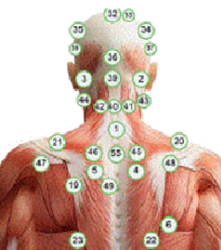
You can see exactly where each one is, with a zoomable map, in our guide to the nine Sunnah points of hijama. Treatment plans for particular conditions usually combine Sunnah points with others chosen for that problem, as in our hijama treatment plans.
Hijama in the golden age of Islamic medicine
The teaching that every disease has a cure encouraged Muslim scholars to observe, record and test treatments. Between the 9th and 13th centuries, physicians in Baghdad, Cairo, Damascus and Cordoba built hospitals (bimaristans), trained doctors and wrote textbooks that were later translated into Latin and used across Europe.
Hijama therapy was part of this tradition. Ibn Sina (Avicenna) described it in his Canon of Medicine (1025 CE), discussing when cupping should be used, where cups should be placed and why it was best done in the middle of the lunar month. The Andalusian surgeon Abu al-Qasim al-Zahrawi also wrote about cupping and its instruments in his great surgical encyclopaedia, al-Tasrif.
Rather than treating hijama as superstition, these physicians tried to explain it in the medical language of their time, and their works helped keep cupping alive in both the Muslim world and Europe for centuries.
What does modern research say about hijama therapy?
Modern scientific research on hijama therapy is still limited, but it is growing. Small clinical trials have reported that wet cupping may reduce pain and improve quality of life in people with chronic low back pain, and may reduce how often and how severely people get headaches. A 2012 review in PLOS ONE of more than a hundred cupping trials found possible benefits for several conditions, while warning that many studies were small and of low quality.
Researchers have suggested a number of ways cupping might work, including reducing pain signals, triggering a local immune response and improving blood flow. Many people also find it deeply relaxing, which may help with stress and sleep. We look at these ideas in more detail in the modern revival of cupping therapy.
The honest conclusion is that the traditional and spiritual reasons for hijama are strong, while the scientific evidence is promising but not yet conclusive. Hijama therapy works best as a complement to conventional medical care, not a replacement for it.
The etiquette (adab) of hijama
Drawing on the Sunnah and the advice of scholars and experienced practitioners, many people follow these guidelines:
- Make a sincere intention to follow the Sunnah and seek healing from Allah.
- Have hijama on an empty stomach, or at least a few hours after a meal.
- Choose a trained, certified therapist who uses sterile, single-use equipment. Many Muslims prefer a therapist of the same gender.
- Rest and eat lightly afterwards, drink plenty of water and avoid strenuous exercise for the rest of the day.
- If you are fasting, be aware that scholars differ on whether cupping breaks the fast. Many people choose to have hijama after iftar during Ramadan.
Who should be careful with hijama therapy?
When it is done properly the risks of hijama therapy are low, but it is not suitable for everyone. Speak to your doctor first if you:
- have a bleeding or clotting disorder, or take blood-thinning medicine
- have anaemia, diabetes or a heart condition
- are pregnant
- have broken skin, varicose veins or active skin disease over the points to be treated
Round marks and mild bruising are normal and usually fade within one to two weeks. Blisters, burns and infections are not normal and are signs of poor technique or hygiene.
Frequently asked questions
Is hijama a Sunnah?
Yes. The Prophet (peace be upon him) was cupped himself, paid the person who cupped him and described cupping as among the best of remedies. It is recommended (Sunnah), not obligatory.
What are the Sunnah days for hijama?
A narration in Sunan Abi Dawud recommends the 17th, 19th and 21st of the Islamic lunar month. Some weaker narrations also prefer Mondays, Tuesdays and Thursdays. Hijama can be done on any day when there is a medical need.
Does hijama break the fast?
Scholars differ. The Prophet (peace be upon him) was reported to have been cupped while fasting, and most schools hold that it does not break the fast, but the Hanbali school holds that it does. Many people avoid the question by having hijama after iftar.
Can women have hijama?
Yes. Women practised and received cupping in early Islam. Many women prefer a female therapist. Hijama is usually avoided during pregnancy unless a doctor agrees.
Where are the Sunnah points?
The narrations mention the top of the head, the two sides of the neck and the area between the shoulders, among others. Our guide to the nine Sunnah points shows each one on a zoomable map.
Follow the Sunnah with confidence. See the nine Sunnah points on our zoomable maps, browse session-by-session hijama treatment plans for 68 conditions, or book a one-to-one consultation.
This article is for general information only and is not medical or religious advice. Always consult your GP or medical practitioner and a certified hijama therapist before treatment, and a qualified scholar for religious rulings.