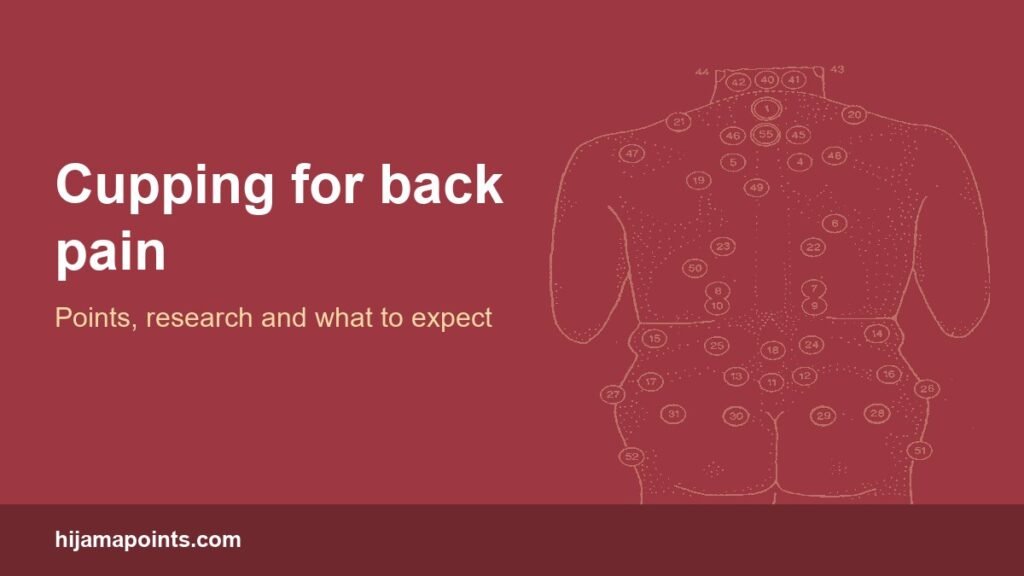
Back pain is one of the most common reasons people try cupping. Elite athletes use it for stiff, overworked muscles, and Hijama Points has treatment plans for back pain, sciatica, and neck and shoulder pain. This guide explains which points are used, what research says about cupping for back pain, what a session involves, and when you should see a doctor first.
At a glance
- Reviews of trials suggest cupping may help reduce back pain in the short term, but the trials are small and the evidence is low quality.
- Across our 8 pain and joint plans, the points used most are 1 and 55 on the upper back, then 11, 12, 13, 41 and 42.
- Both dry cupping and hijama (wet cupping) are used. A course of sessions is common.
- Some back pain needs urgent medical help first: see the warning signs below.
What does the research say about cupping for back pain?
A 2017 review of six randomised trials on low back pain found that cupping lowered pain and disability scores compared with control treatments, with no serious side effects reported, but the trials varied widely and had a high risk of bias. A 2023 review rated the evidence for back and neck pain as low to moderate. A 2020 review of chronic pain more generally found less pain in the short term compared with no treatment, but not clearly compared with sham cupping.
In short, cupping may help back pain alongside usual care such as staying active, exercise and advice from your doctor or physiotherapist. It is not a cure, and results vary from person to person.
Which cupping points are used for back pain?
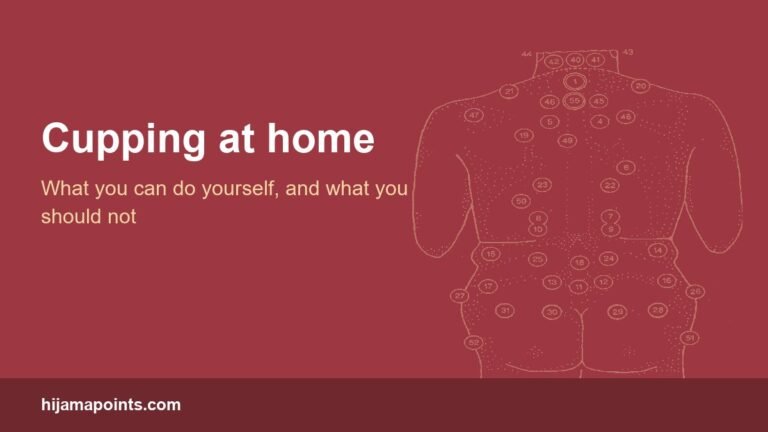
Points are chosen by the therapist from where the pain is, traditional practice and experience. Across all our treatment plans, points 1 and 55 on the upper back are used most. Besides those, our 8 pain and joint plans most often use:
- Point 11: the prominent lumbar vertebra at the lower back.
- Points 12 and 13: either side of point 11, about 5cm from the spine.
- Points 41 and 42: the back of the head and neck, right and left.
You can see where each one is on our back of the body map and on the full hijama and cupping points chart. Our hijama points for back pain plan sets out the points for each session, and there are separate plans for sciatica and neck and shoulder pain.
Dry cupping or hijama for back pain?
Both are used. Dry and moving cupping are common for muscle tightness and sports-related back pain. Hijama is often chosen as part of a course for longer-term back pain, usually on the upper and lower back. Our back pain plan uses wet and dry cupping across five sessions. See dry cupping vs wet cupping for how they differ.
What to expect in a back pain session
- Your therapist asks about your back pain, your health and any medicines.
- You lie face down. Cups are placed on the chosen points for a few minutes.
- For hijama, light shallow scratches are made and the cups go back on to draw a little blood.
- Expect round marks for one to two weeks and some tenderness for a day or two.
- Sessions are usually two to four weeks apart in a course.
When to see a doctor before cupping
Most back pain is not serious, but get urgent medical help, and do not have cupping, if back pain comes with:
- numbness or tingling around your bottom or genitals
- loss of bladder or bowel control, or difficulty peeing
- weakness or numbness in one or both legs that is getting worse
- a fever, or you feel generally unwell
- pain after a fall or injury
- unexplained weight loss
In an emergency, call your local emergency services. Also talk to your doctor before cupping if you have a bleeding or clotting disorder, take blood-thinning medicines, have anaemia, are pregnant, have diabetes or have a heart condition. Read more about cupping side effects.
Frequently asked questions
How many cupping sessions are needed for back pain?
It varies. Our back pain plan has five sessions, usually two to four weeks apart. Some people notice a difference sooner, others later, and some not at all.
Is cupping good for lower back pain?
Small trials suggest cupping may reduce lower back pain in the short term, but the evidence is low quality. It is best used alongside usual care.
Can cupping help sciatica?
There is little research specific to sciatica. We have a separate sciatica plan. If sciatica comes with leg weakness or bladder or bowel changes, get urgent medical help first.
Can I have cupping with a slipped disc?
Talk to your doctor first. Cups should not be placed over a fresh injury, and a therapist should know about any diagnosis before treatment.
Sources and further reading
- Wang YT et al. Cupping therapy for low back pain: a systematic review and meta-analysis – Journal of Back and Musculoskeletal Rehabilitation, 2017
- Mohamed AA, Zhang X, Jan YK. Evidence-based and adverse-effects analyses of cupping therapy in musculoskeletal and sports rehabilitation – Journal of Back and Musculoskeletal Rehabilitation, 2023
- Cramer H et al. Cupping for chronic pain: a systematic review and meta-analysis – Journal of Pain, 2020
- Back pain – NHS
- Sciatica – NHS