Cupping, including hijama (wet cupping), is generally well tolerated when a trained therapist uses clean, and for wet cupping sterile, equipment. Like any hands-on treatment it has side effects, most of them mild and short-lived. This guide sets out what is expected, what is rare, who should take extra care and when to get help.
At a glance
- Expected: round marks, mild soreness, small scratch marks after wet cupping, and feeling tired or light-headed straight afterwards.
- Rare but reported: lasting skin discolouration, scars, burns and infections, flare-ups of eczema or psoriasis, and anaemia after repeated wet cupping.
- Talk to your doctor first if you have a bleeding or clotting disorder, take blood thinners, have anaemia, are pregnant, have diabetes or a heart condition.
- Blisters, burns, spreading redness, pus or fever are not normal: get medical advice.
Common side effects of cupping
| What you may notice | What it usually means | How long |
|---|---|---|
| Round marks or bruising | Normal: they come from the suction | Usually fade within one to two weeks |
| Mild soreness or tenderness | Normal, like after a deep massage | A day or two |
| Small scratch marks (wet cupping) | Normal: from the light, shallow scratches | Heal over a few days |
| Tiredness or light-headedness | Common straight after treatment: rest and drink water | The same day |
Reviews of cupping trials have found side effects to be mostly mild and temporary. Our guide to cupping marks explains the marks in more detail.
Rarer side effects and risks
The US National Center for Complementary and Integrative Health notes that cupping can cause lasting skin discolouration, scars, burns and infections, and may make eczema or psoriasis worse. Burns are mainly a risk with fire cupping. Infection is the main risk with wet cupping when equipment is not sterile or cups are reused: using the same equipment on more than one person without sterilisation can spread bloodborne infections such as hepatitis B and C. That is why blades and cups for hijama must be single-use and never shared.
Rare serious cases have also been reported, such as anaemia from blood loss after repeated wet cupping, and bleeding inside the skull after cupping on the scalp. This is one reason a therapist spaces sessions out and treats the head with care.
Some people feel faint during or after a session, especially if they have not eaten, are dehydrated or are nervous about blood. Telling your therapist, eating a light meal beforehand and lying down for treatment all help.
Who should check with a doctor before cupping?
Talk to your doctor before cupping, and especially before wet cupping, if you:
- have a bleeding or clotting disorder
- take blood-thinning medicines
- have anaemia
- are pregnant
- have diabetes
- have a heart condition or a pacemaker
Always tell your therapist about any medical conditions and medicines before treatment. Cupping is a complementary therapy: it should support, never replace, care from your doctor.
Where cups should not be placed
- Broken, burnt, infected or very thin skin, and areas of active skin disease.
- Varicose veins.
- Over a fresh injury, a fracture or a recent operation site.
- The face with a blade: therapists use dry cupping or a fine pin instead, to avoid scars.
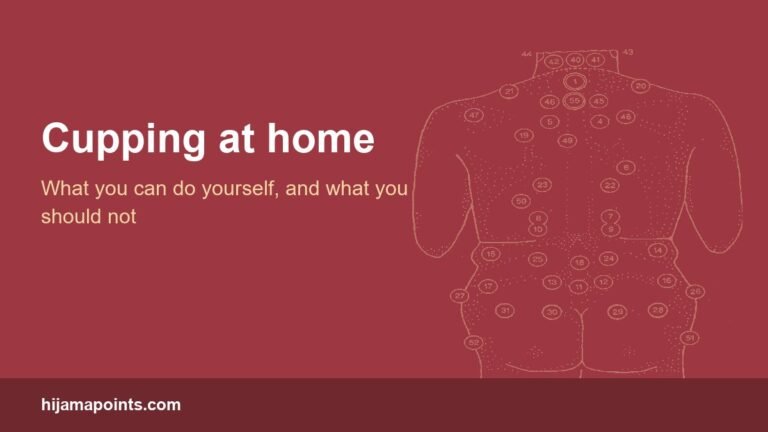
Our hijama and cupping points chart marks the areas therapists treat with extra care.
How to lower the risks
- Choose a trained, experienced therapist and ask how they sterilise or dispose of equipment.
- For wet cupping, make sure blades and cups are sterile, single-use and opened in front of you.
- Eat a light meal and drink water beforehand.
- Tell your therapist if suction feels too strong.
- Rest afterwards and keep the area clean until any scratches have healed.
When to get help
Get medical advice if you notice blisters or burns, spreading redness, heat, swelling or pus, a fever, scratches that keep bleeding, or if you feel unwell in the days after treatment. In an emergency, call your local emergency services.
Frequently asked questions
Is it normal to feel tired after cupping?
Yes, many people feel tired or a little light-headed straight after a session. Rest, drink water and eat something light. If it lasts or you feel unwell, get medical advice.
Can cupping leave scars?
Round marks normally fade completely. Scarring is rare and is most often linked to burns from fire cupping, deep cuts or infection, which is why technique and hygiene matter.
Can cupping make eczema or psoriasis worse?
It can. Cups should not be placed on areas of active skin disease, and if you have a skin condition, talk to your doctor and your therapist first.
Can I exercise after cupping?
Many therapists advise taking it easy for the rest of the day, particularly after wet cupping, and avoiding very hot baths or saunas for a day or so.
Sources and further reading
- Cupping – US National Center for Complementary and Integrative Health
- Kim S et al. Cupping therapy for neck pain: a systematic review and meta-analysis – BMJ Open, 2018
- Mohamed AA, Zhang X, Jan YK. Evidence-based and adverse-effects analyses of cupping therapy in musculoskeletal and sports rehabilitation – Journal of Back and Musculoskeletal Rehabilitation, 2023