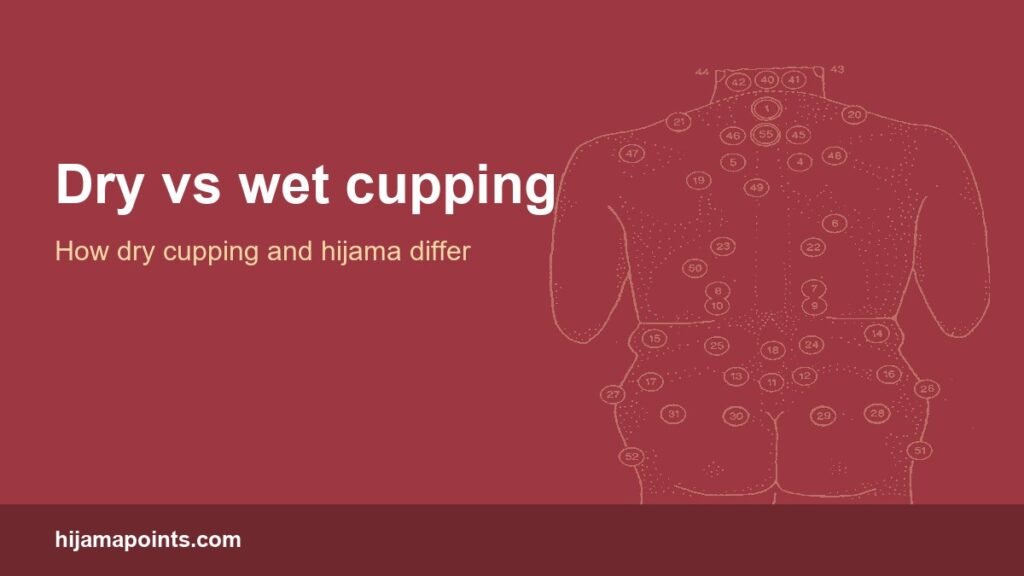
Cupping comes in two main forms. Dry cupping uses suction alone. Wet cupping, known in Arabic as hijama, adds light scratches so that a small amount of blood is drawn into the cup. Both use the same cups and the same points on the body, but they are different treatments with different safety needs.
At a glance
- Dry cupping: cups and suction only, no blood drawn.
- Wet cupping (hijama): cups, then light shallow scratches, then the cups again to draw a little blood.
- Both use the same numbered points, so hijama points and cupping points are the same places on the body.
- Wet cupping needs a trained therapist and sterile, single-use equipment. Most research so far is on dry cupping.
What is dry cupping?
In dry cupping, the therapist places cups on the skin and removes air with a hand pump, a squeeze bulb (silicone cups) or, in fire cupping, a brief flame. The suction lifts the skin into the cup. Cups are usually left in place for a few minutes, moved over oiled skin (moving or massage cupping), or put on and taken off quickly (flash cupping). Dry cupping is widely used by sports therapists and massage therapists for muscle tension and pain.
What is wet cupping (hijama)?
Hijama starts the same way. After a few minutes the cup is removed, the therapist makes a few light, shallow scratches in the skin with a sterile blade, and the cup is put back on. The suction draws a small amount of blood into the cup, which is then removed and safely disposed of. Hijama has a special place in Islamic tradition: the Prophet Muhammad (peace be upon him) was cupped and spoke of its value, which you can read about in hijama in Islam.
Dry cupping vs wet cupping at a glance
| Dry cupping | Wet cupping (hijama) | |
|---|---|---|
| Method | Suction only | Suction, light scratches, then suction again |
| Blood drawn | No | A small amount |
| Equipment | Reusable cups that are cleaned between clients | Sterile, single-use blades and cups, never shared |
| Marks | Round marks that fade in one to two weeks | Round marks plus small scratch lines that heal in days |
| Who should do it | A trained therapist; gentle dry cupping is sometimes done at home | A trained therapist only |
| On the face | Yes, with light suction | Avoided: a blade can scar, so a fine pin or dry cupping is used |
| Research | Most studies so far | Fewer studies |
Do dry and wet cupping use the same points?
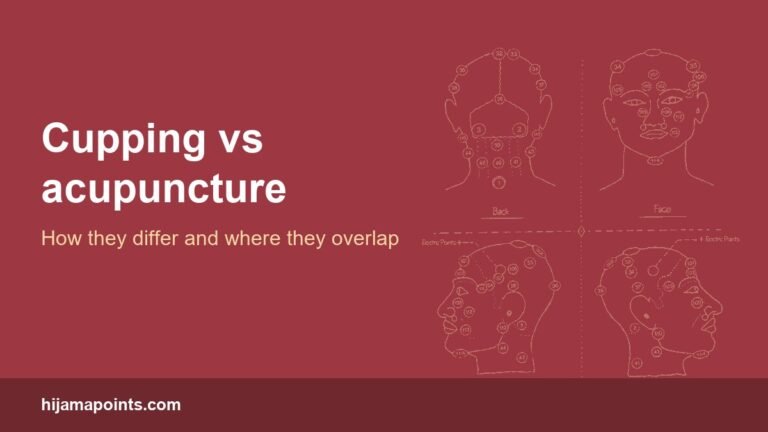
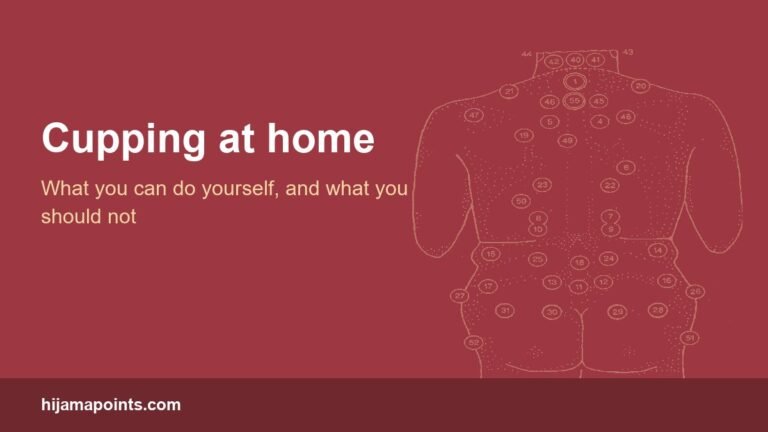
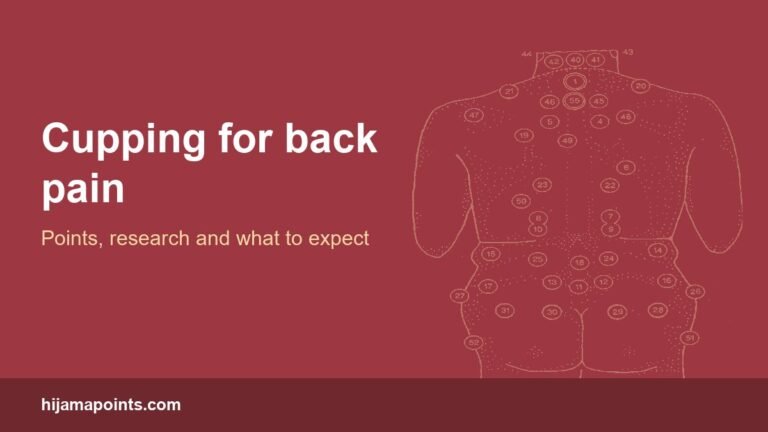
Yes. Cupping points are the places on the body where cups are placed, and in wet cupping they are called hijama points. The same numbered points are used for both, which is why our hijama and cupping points chart covers dry cupping and hijama together. A treatment plan may use wet cupping on some points and dry cupping on others: across our treatment plans, most points are used for wet cupping, while the face and some sensitive areas are kept to dry cupping.
Which is better, dry or wet cupping?
There is no good research comparing the two head to head, so no one can honestly say that one works better. The choice usually depends on:
- Your goal: dry and moving cupping suit muscle tension and sports recovery; many people choose hijama for its place in the Sunnah and for a course of treatment for a specific concern.
- Your health: wet cupping is not suitable for everyone. Talk to your doctor first if you have a bleeding or clotting disorder, take blood-thinning medicines, have anaemia, are pregnant, have diabetes, or have a heart condition or a pacemaker.
- The area: the face and some sensitive areas are better suited to dry cupping.
- Who is treating you: wet cupping must only be done by a trained therapist with sterile equipment.
What does the research say?
Most cupping trials have studied dry cupping, and most have been small. A 2023 review of 22 studies, most of them on dry cupping, rated the evidence as moderate for soft-tissue flexibility and low to moderate for back and neck pain, with rare side effects. A 2020 review of trials on chronic pain found less pain in the short term compared with no treatment, but not clearly compared with sham cupping. Evidence specific to wet cupping is more limited. Cupping is best seen as a complementary therapy that may help alongside, never instead of, care from your doctor.
Frequently asked questions
Is wet cupping more effective than dry cupping?
There is not enough research comparing them directly to say. They suit different goals and different people, so talk to a trained therapist about which fits you.
Does wet cupping hurt?
The scratches are light and shallow. Most people feel a brief sting or scratch, then the same firm pull as dry cupping.
Can I have dry cupping and hijama in the same session?
Yes. Many plans use wet cupping on some points and dry cupping on others, for example dry cupping on the face.
Can I do either at home?
Gentle dry cupping is sometimes done at home with silicone or pump cups. Wet cupping should only be done by a trained therapist. See our guide to cupping at home.
Sources and further reading
- Mohamed AA, Zhang X, Jan YK. Evidence-based and adverse-effects analyses of cupping therapy in musculoskeletal and sports rehabilitation – Journal of Back and Musculoskeletal Rehabilitation, 2023
- Cramer H et al. Cupping for chronic pain: a systematic review and meta-analysis – Journal of Pain, 2020
- Cupping – US National Center for Complementary and Integrative Health